
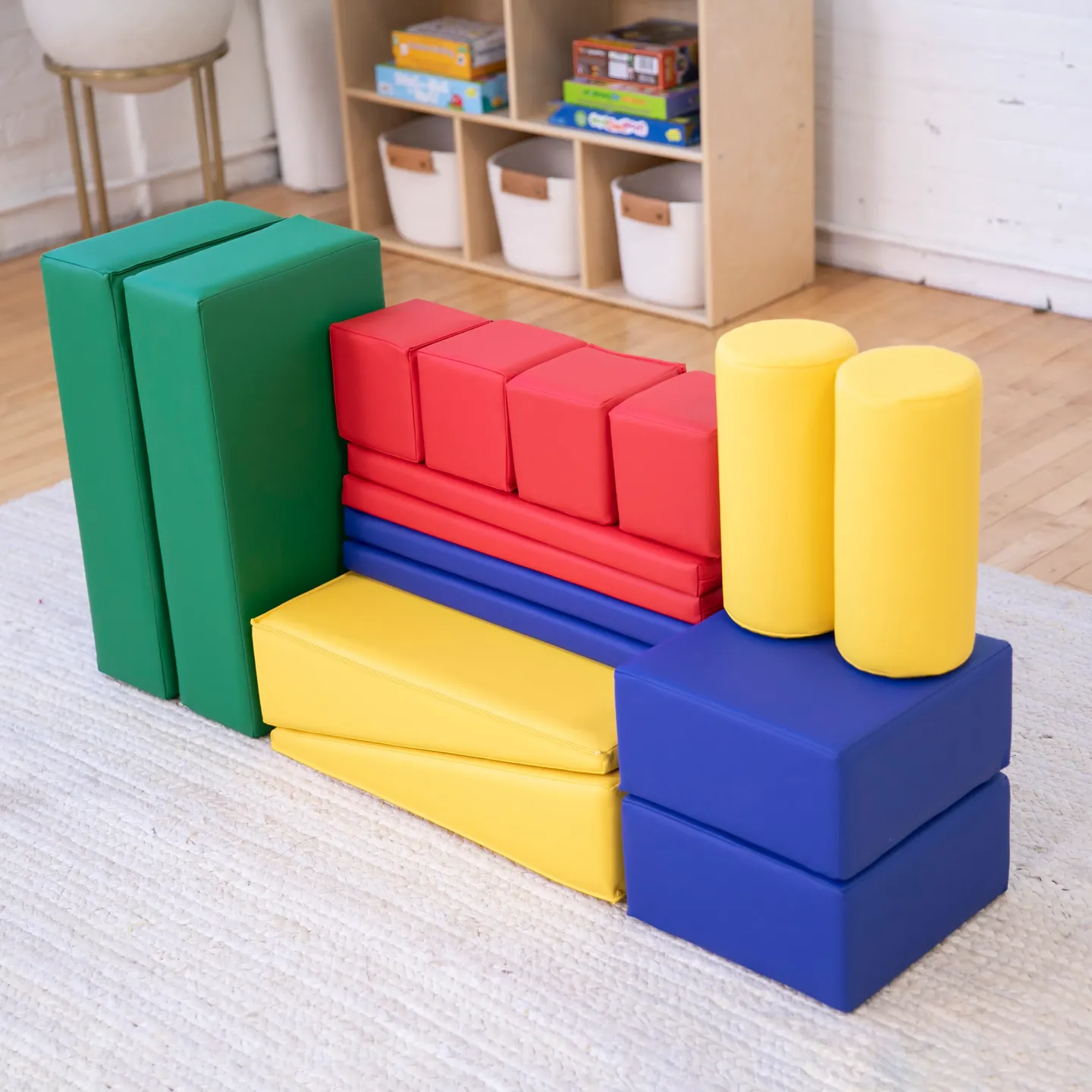
Giant Building Blocks are an exciting way to transform indoor spaces into places for creativity, discovery, and hands-on learning. Giant Building Blocks allow children to stack, arrange, connect, and redesign oversized pieces while exploring their own ideas. With Giant Building Blocks, a simple playroom, classroom, daycare center, or activity area can become an imaginative construction environment. These versatile building toys encourage children to experiment with shapes, balance, space, and structure while enjoying screen-free entertainment that can develop both physical and cognitive skills.
What Makes Indoor Exploration Valuable?
Children learn by interacting with the world around them. When outdoor exploration is not possible because of rain, limited space, or other circumstances, indoor activities can provide equally valuable opportunities for discovery.
Construction play gives children something tangible to investigate. They can test what happens when blocks are stacked in different ways, compare structures, and discover how individual pieces work together.
Giant Building Blocks are especially useful for this type of exploration because their larger format makes construction concepts easy to see and understand.
Encouraging Curiosity
Children naturally ask questions such as “How high can I build?” or “Can I make this stand without falling?” Construction activities allow them to find answers through experimentation.
Rather than receiving every answer from an adult, children can test different ideas themselves. This encourages curiosity and independent thinking.
Creating Open-Ended Play
Open-ended toys can be used in many different ways. There is no single finished design that children must reproduce.
A group of blocks can become a house, tower, bridge, animal habitat, castle, or futuristic building. Each new idea creates another opportunity for exploration. For more information about large building blocks for kids, explore their features, benefits, age suitability, and role in encouraging imaginative and educational play.
Creative Activities With Giant Building Blocks
There are countless ways to use large construction pieces for indoor discovery. Parents and educators can introduce simple challenges while allowing children to make their own decisions.
Build a Tall Structure
Ask children to create the tallest stable tower they can. They can test different foundations and discover how the arrangement of blocks affects stability.
This activity introduces basic engineering concepts while encouraging children to move around and carefully position each piece.
Create a Miniature Neighborhood
Children can build homes, schools, stores, parks, garages, and roads. They can decide how the different buildings should be arranged.
Giant Building Blocks make it easy to expand the neighborhood as new ideas appear. Children can add buildings, redesign streets, and create stories involving the people who live there.
Construct Bridges and Tunnels
Bridges and tunnels introduce interesting structural challenges. Children can experiment with supports and openings to see which arrangements work best.
These projects encourage children to think about balance, distance, weight, and stability while using their imagination.
Educational Benefits of Indoor Construction
Creative construction is more than entertainment. It can support multiple areas of child development.
Developing Spatial Reasoning
When children arrange blocks, they learn how objects relate to one another. Concepts such as height, width, direction, position, distance, and depth become easier to understand through physical interaction.
Giant Building Blocks provide a practical way to explore these concepts because children can directly manipulate the objects.
Supporting Problem-Solving
Construction often involves unexpected challenges. A structure might collapse, a piece might not fit, or a design may not provide enough space.
Children can identify the issue and experiment with alternatives. This process teaches persistence and encourages flexible thinking.
Building Coordination
Moving and positioning oversized pieces requires children to coordinate their hands, eyes, and bodies. They learn to control their movements while focusing on a specific construction goal.
This can support hand-eye coordination and general body awareness.
Giant Building Blocks and Imaginative Play
Construction becomes even more powerful when children combine it with storytelling.
Creating Imaginary Worlds
A tower can become a wizard's castle, a group of buildings can become a city, and a tunnel can become a secret passage.
Children can invent characters and stories around their structures. This encourages creativity while also supporting language and communication skills.
Role-Playing Through Construction
Children can use their finished structures as settings for pretend play. They might pretend to be architects, builders, explorers, shopkeepers, astronauts, or community planners.
Giant Building Blocks provide a physical environment that can change as the story develops.
Exploring Science and Early Engineering
Indoor construction offers an accessible introduction to STEM concepts.
Learning About Balance
Children quickly discover that a narrow or uneven foundation may make a structure unstable. They can experiment with wider bases and different arrangements.
These simple experiences introduce the relationship between structure and stability.
Understanding Cause and Effect
When a child moves one block and the entire structure changes, they observe cause and effect directly.
This type of experimentation encourages children to ask questions, make predictions, and observe results.
Exploring Shapes and Patterns
Blocks can be sorted according to shape, size, or color. Children can create repeating patterns or identify geometric forms within their structures.
These activities connect creative play with early mathematical concepts.
Using Giant Building Blocks at Home
Parents can create a dedicated construction area where children have easy access to their building materials.
Create a Building Station
Choose an open section of the playroom or living area. Keep blocks in an accessible container so children can start projects independently.
A carpet or play mat can make floor-based construction more comfortable and help define the building area.
Introduce Weekly Themes
Parents can keep play interesting by choosing a different theme each week. Ideas include farms, airports, castles, space stations, animal parks, and underwater cities.
The theme provides inspiration without restricting the child's creativity.
Using Giant Building Blocks in Educational Settings
Teachers can incorporate large construction pieces into classroom learning centers.
STEM Activities
Students can build bridges, towers, geometric structures, and other designs while discussing concepts such as balance, measurement, shape, and stability.
Giant Building Blocks can make abstract ideas more tangible by allowing students to physically demonstrate what they have learned.
Collaborative Projects
Small groups can work together on a large structure. Children can divide responsibilities, exchange materials, discuss designs, and solve problems collectively.
This supports cooperation, communication, and teamwork.
Choosing the Right Construction Blocks
When selecting oversized construction toys, consider age suitability, materials, size, weight, storage requirements, and available play space.
Consider Material and Design
Choose products made from child-appropriate materials and inspect them regularly. Lightweight designs can be easier for younger children to handle.
Always follow the manufacturer's recommended age range and safety instructions.
Think About Available Space
Large pieces need sufficient room for building and movement. Measure the intended play area before selecting a set.
Adequate space allows children to explore their structures without unnecessary obstacles.
Safety Tips for Indoor Exploration
Children should have a clear and organized area for construction. Keep blocks away from stairs, sharp furniture edges, and other potential hazards.
Encourage children to carry and place pieces carefully rather than throwing them. Inspect blocks regularly and remove damaged pieces from use.
For younger children, adult supervision should be provided according to the product's safety recommendations.
Making Indoor Exploration More Engaging
Adults can encourage deeper exploration by asking open-ended questions. Instead of telling children exactly how to build, ask questions such as, “What could make your tower stronger?” or “How can you connect these two buildings?”
These questions encourage children to develop their own solutions.
Giant Building Blocks can also be combined with books, drawing, and storytelling. After reading a story about a castle, children could build their own castle. After learning about animals, they could create habitats for imaginary creatures.
Frequently Asked Questions
1. What are Giant Building Blocks used for?
Giant Building Blocks can be used for construction, imaginative play, STEM activities, storytelling, spatial-learning exercises, and collaborative projects.
2. Are large building blocks suitable for indoor activities?
Yes. They can be used in homes, classrooms, daycare centers, and other suitable indoor spaces, provided there is enough room for safe construction.
3. What skills can children develop through block play?
Children can develop creativity, spatial reasoning, coordination, planning, problem-solving, communication, persistence, and early mathematical thinking.
4. Can Giant Building Blocks support STEM learning?
Yes. Children can explore balance, shapes, patterns, measurement, stability, and cause-and-effect relationships through hands-on construction.
5. How can parents make indoor block play more creative?
Parents can introduce themes, building challenges, storytelling prompts, and simple STEM experiments. Giving children freedom to design their own structures can make the experience even more engaging.
Conclusion
Giant Building Blocks provide an engaging foundation for creative indoor exploration. They give children the freedom to build, experiment, redesign, and imagine while developing valuable physical and cognitive skills. From simple towers and patterns to elaborate cities and imaginary worlds, construction play can adapt to different ages, interests, and learning goals.
Whether used at home or in educational environments, Giant Building Blocks can turn ordinary indoor time into an opportunity for discovery. Children can explore balance, shape, space, teamwork, storytelling, and problem-solving through hands-on experiences. With appropriate materials, sufficient space, and responsible supervision, oversized construction pieces can provide an enjoyable and educational way for children to explore their creativity indoors.